Flowpixy
Mode Grid
Mode Grid
Couldn't load pickup availability
Share
Self-paced learning overview
- 🎓 Digital learning materials
- 🗂️ Organized course modules
- 🔐 Secure checkout
- 🆕 Updated for 2026
1. Problem Statement
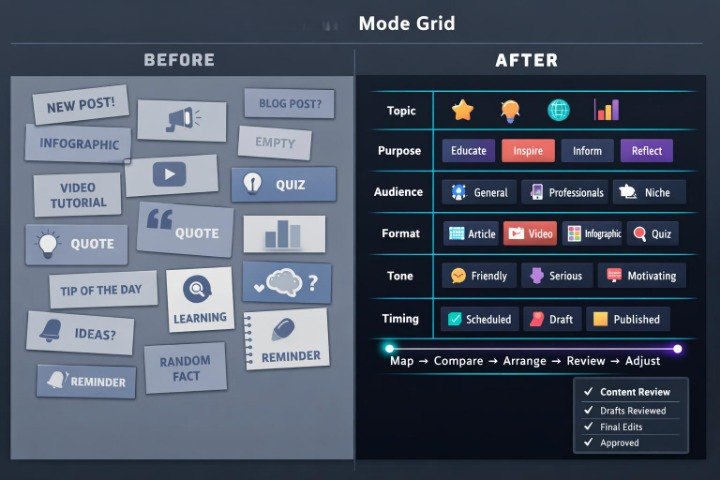
Struggling to manage different types of content without making the overall plan feel disconnected? You're not alone. Many learners begin using several communication formats but find it difficult to understand where each one fits and how often it should appear. Without a clear framework, similar topics may repeat, important themes may receive too little attention, and the overall sequence may feel uneven. It can also be challenging to compare different approaches when every material is planned in isolation. Mode Grid was created to help learners organize multiple content modes within one clear planning structure.
2. Solution
This course will teach you how to build a content grid that connects format, purpose, audience, tone, and timing. You will learn how to compare different communication modes, arrange them within a balanced plan, and review whether each item supports the wider content direction. The course explains how to create repeatable planning categories without making the materials feel identical. It also introduces practical ways to track topic distribution, message variety, and calendar balance. Mode Grid supports independent study through detailed modules, comparison exercises, and planning templates.
3. What’s Inside
Module 1: Content Modes — you will learn how to identify different communication modes, including educational, explanatory, reflective, informational, and community-focused materials.
Module 2: Grid Structure — you will explore how to build a planning grid that connects topics, formats, audience needs, and communication purposes.
Module 3: Purpose Mapping — you will learn how to assign a clear purpose to each material and avoid adding content without a defined role.
Module 4: Format Comparison — you will study how to compare short notes, detailed explanations, lists, topic series, and visual-led materials.
Module 5: Audience Match — you will explore how different audience groups may respond to different levels of detail, tone, and presentation.
Module 6: Topic Distribution — you will learn how to spread content themes across a calendar without creating unnecessary repetition.
Module 7: Message Variation — you will study how to communicate related ideas through different structures while keeping the main direction consistent.
Module 8: Grid Review — you will learn how to check balance, clarity, variety, and connection across the full planning layout.
Module 9: Adjustment Process — you will explore how to revise the grid by moving topics, changing formats, and improving the sequence.
Module 10: Practical Grid Project — you will create a sample content grid with defined modes, topic groups, audience notes, message purposes, and a review section.
4. Who Is This For?
✅ Good fit if you:
- want to work with several content formats;
- need a structured way to compare communication modes;
- want to improve balance across a wider content plan;
- prefer detailed planning templates and review exercises;
- want to organize topics, formats, and purposes within one system.
❌ Not for you if:
- you expect immediate commercial outcomes;
- you are looking for claims about clients, payment, or employment;
- you want instructions tied to named platforms;
- you do not plan to complete comparison and planning exercises.
5. What You’ll Learn
- How to identify different content modes.
- How to build a structured planning grid.
- How to connect each material with a clear communication purpose.
- How to compare formats for different topics.
- How to match tone and detail with audience needs.
- How to distribute themes across a content calendar.
- How to create variation without losing consistency.
- How to review balance across a full plan.
- How to adjust the grid after evaluation.
- How to create a complete sample content grid for independent practice.
6. Review Period
Mode Grid includes structured course materials for independent learning. If the course does not meet your expectations, you may request a refund within 30 days according to the store policy. This gives you time to review the materials and decide whether the course format fits your learning needs.
Is this course suitable for beginners?
Is this course suitable for beginners?
Yes. Flowpixy courses are built for gradual learning, with structured topics, clear explanations, and practical materials for independent study.
What is included in the course?
What is included in the course?
The course includes organized modules, learning materials, examples, explanations, and tasks for independent practice.
Do I need previous SMM experience?
Do I need previous SMM experience?
No. The materials can be studied from a basic level and are arranged to help learners develop content-related skills step by step.
How is the learning organized?
How is the learning organized?
The course is divided into logical sections: SMM basics, audience understanding, content topics, message structure, planning, and material review.